


BTTS Betting and 7 Critical Mistakes to Avoid
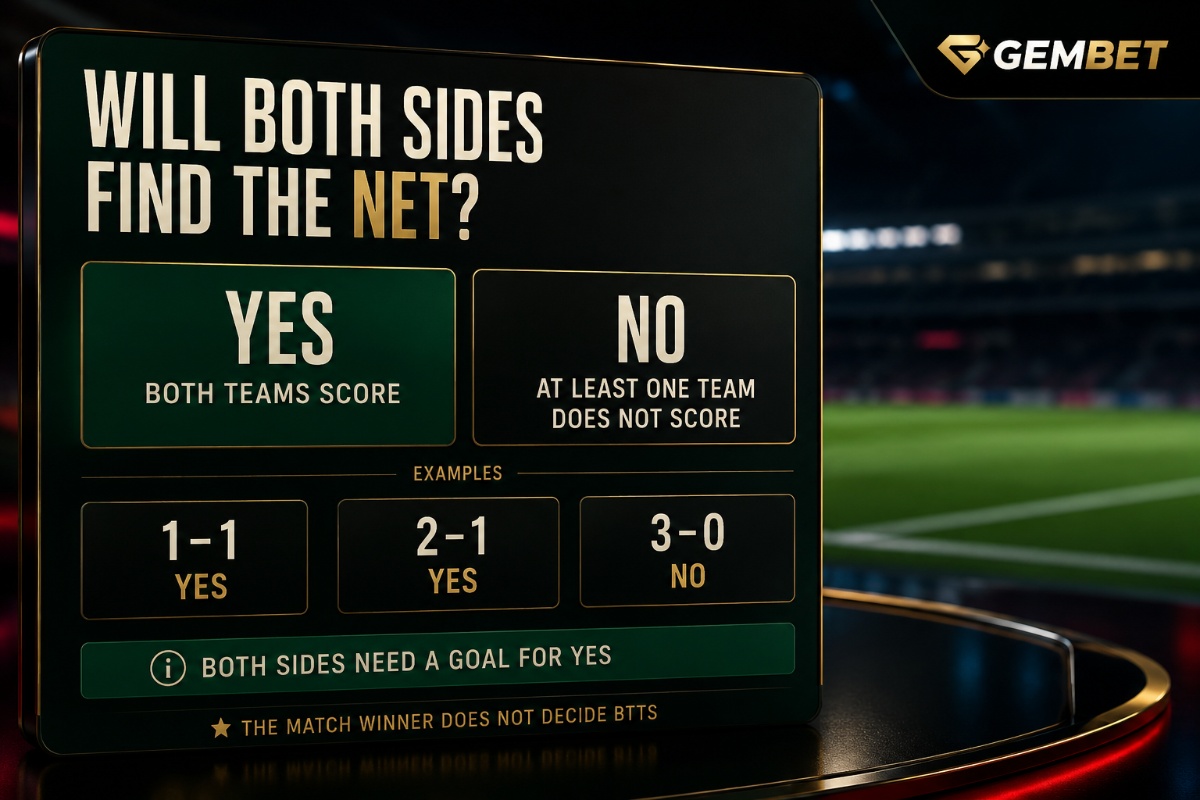
BTTS betting is a football market based on one question: will both teams score at least once during the stated match period? On Gembet, the market is usually offered as Yes or No. Yes needs each side to score, while No wins when at least one team finishes without a goal.
This looks simple but can be misread. A 4-0 home win can settle No, while a 1-1 draw can settle Yes. The key details are the scoring condition, settlement period, and whether the market sits alone or inside a combination.
What does BTTS betting mean?
BTTS betting stands for Both Teams to Score. You are not predicting which side wins or how many total goals the match produces. You are predicting whether each team records at least one qualifying goal before the stated settlement period ends.
For Yes, both sides must score. For No, one clean sheet is enough. A 0-0 result also settles No because neither side has scored.
BTTS betting does not depend on the match winner
The first mistake is linking this market too closely to the result market. A team can dominate the match and still produce a losing Yes selection if the opponent never scores.
Consider three fictional scorelines. A 3-1 home win settles Yes. A 1-2 away win also settles Yes. A 5-0 home win settles No. The direction of the victory changes, but the scoring condition stays the same.
One goal from each side is enough for Yes
BTTS betting does not require a high-scoring match. A 1-1 result satisfies Yes just as clearly as 4-3 because both sides have scored at least once.
This is why the market should not be treated as another name for Over 2.5 goals. The two markets can overlap, but they ask different questions.
BTTS and total goals can settle differently
A match can finish with several goals while only one team scores. A 3-0 result has three total goals, yet BTTS betting settles No. By contrast, a 1-1 result has only two goals and settles Yes.
| Score | BTTS Yes | Over 2.5 Goals |
|---|---|---|
| 1-1 | Win | Loss |
| 2-1 | Win | Win |
| 3-0 | Loss | Win |
| 0-0 | Loss | Loss |
The table shows why BTTS betting needs to be judged from the scoring condition rather than from an expectation of an entertaining or high-scoring match.
Regular time normally controls settlement
Gembet’s current market guide says Both Teams to Score is normally settled from regular time unless otherwise stated. Extra time and penalties are excluded from the standard football version.
That means a knockout match could finish 0-0 after 90 minutes and later become 1-1 in extra time, while the original BTTS betting market still settles from the score at the end of regular time. Read the period before confirming.
Do not assume every goal counts the same way
BTTS betting depends on goals recognised for the market under the sportsbook’s rules. Own goals normally contribute to the match score, but unusual events such as abandoned matches, overturned goals, or settlement corrections can require the operator’s specific rules.
Use the settled event record and official market terms rather than trying to reconstruct an unusual situation from a live animation.
BTTS No does not mean predicting 0-0
Another common error is treating No as a scoreless-match prediction. No wins whenever at least one side fails to score. Results such as 1-0, 2-0, 0-2, and 0-0 all satisfy that condition.
This gives No several possible score paths, just as Yes covers any score where both teams register at least one goal.
Team form needs context
Recent scorelines provide context, but BTTS betting should not be based on streak count alone. Opponent quality, venue, injuries and lineup changes can affect how relevant past matches are.
Five recent Yes results do not force the next fixture to produce another.
Clean-sheet data answers only part of the question
The market requires information about both attack and defence. A team that rarely keeps clean sheets may still face an opponent with very weak scoring numbers. Likewise, a strong attack can meet a defence that suppresses chances effectively.
Looking at only one team’s defensive record leaves half of the market condition unexplored.
Home and away splits can change the picture
A club’s overall season numbers can hide different patterns by venue. BTTS betting research is stronger when home scoring for the host and away scoring for the visitor are checked separately.
A team might score consistently at home but struggle away, or concede frequently on the road while remaining much tighter in its own stadium. Venue-specific data can therefore add useful context without guaranteeing the outcome.
Check whether important attackers are actually available
Lineups can materially change the logic behind BTTS betting. A team may have strong season scoring numbers while entering the next match without its leading striker or key creator.
Current personnel and tactical changes can make older data less representative of the fixture being priced.
Price still matters in BTTS betting
Choosing Yes or No is only half of BTTS betting. The sportsbook also assigns decimal odds to each side of the market. A selection can sound plausible while offering a price that already reflects much of that expectation.
At decimal odds of 1.85 with an SGD 20 stake, the basic potential payout would be:
SGD 20 × 1.85 = SGD 37
This is a payout calculation, not evidence that the selection is likely to win.
Live BTTS markets change after goals and elapsed time
When BTTS betting is offered in-play, the current score changes the condition. If one side has already scored, a Yes selection effectively needs the other side to score before the relevant period ends.
The odds can also move quickly as time passes or important events occur. Check the accepted market and price in the bet slip because the number visible several moments earlier may no longer be available.
Adding BTTS to a combo creates another dependency
BTTS betting can be used inside a multi-event wager where the sportsbook permits it. The fact that the market covers many possible scorelines does not make the leg automatic. If Yes requires both sides to score and one finishes goalless, that leg loses.
If you are combining several fixtures, the combo bets guide explains why each additional selection adds another condition that must normally settle successfully.
How BTTS betting differs from nearby football markets
| Market | Main question | Example winning condition |
|---|---|---|
| BTTS Yes | Do both teams score? | 1-1 |
| BTTS No | Does at least one team fail to score? | 2-0 |
| Match Winner | Who wins? | Home finishes ahead |
| Over 2.5 | Are there at least three goals? | 3-0 |
The comparison keeps BTTS betting separate from markets that may look related on the same match page.
Seven critical mistakes worth avoiding
- Assuming a high-scoring match automatically means both teams will score.
- Treating BTTS No as only a 0-0 prediction.
- Ignoring whether settlement uses regular time or another period.
- Relying on streaks without checking opponent and venue context.
- Using season scoring averages without reviewing current team news.
- Comparing Yes and No without checking the accepted odds.
- Adding the market to a combo simply because it looks straightforward.
A quick BTTS betting research routine
Start by checking whether both sides regularly create and concede meaningful chances in the relevant home and away setting. Then review recent team news, likely lineups, and the market price. Finally, compare Yes and No against the exact settlement period.
The goal is to make sure the selection reflects the actual fixture rather than a headline statistic or recent streak.
What if one team never takes a shot on target?
The number of shots does not settle BTTS betting. Only qualifying goals matter. A team could create many chances and fail to score, while another could score from its only meaningful attempt.
Statistics can inform analysis, but settlement is determined by the stated scoring condition.
Gembet lists Both Teams to Score as a common market
Gembet’s current Sportsbook Help Center describes Both Teams to Score as a Yes or No market asking whether both sides will score at least once. It says Yes wins when both teams score and No wins when one or both teams fail to score. The standard market is settled on regular time unless stated otherwise.
BTTS betting is simple once the score condition stays central
BTTS betting becomes easier to evaluate when the match winner, total-goal expectation, and recent streaks are kept separate from the actual requirement. Yes needs one qualifying goal from each team. No needs at least one side to remain scoreless.
On Gembet, confirm the settlement period, current odds, and whether the selection is being placed alone or inside a larger slip. Those details matter even though the core market has only two choices.
The best way to read BTTS betting is therefore straightforward: focus first on whether both teams can satisfy the scoring condition, then decide whether the offered price matches that view without treating any past pattern as a guarantee.
Experience the real deal with SG's top Live Dealers. Play Baccarat, Roulette & more.

