


Draw No Bet and 7 Critical Errors Bettors Should Avoid
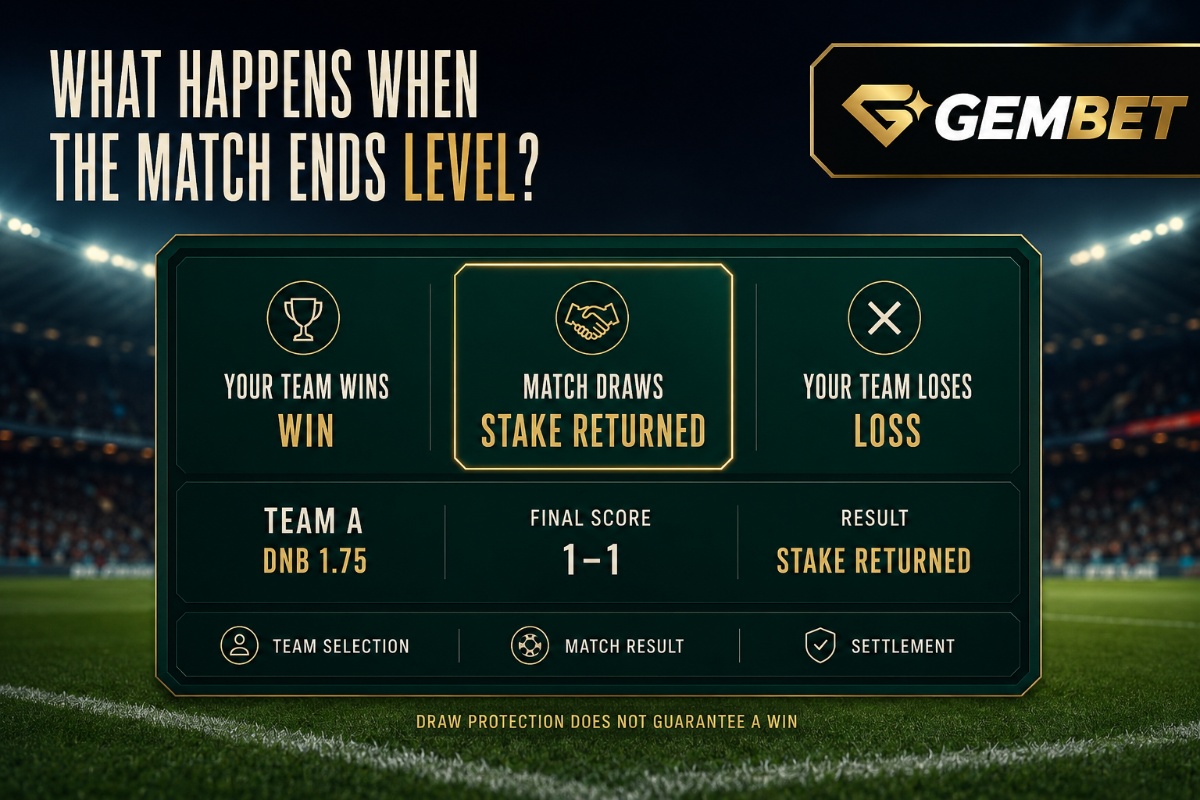
Draw no bet is a football market that lets you back one team while removing the draw as a losing result. If your team wins, the selection wins. If it loses, the selection loses. If the match finishes level during the stated settlement period, the stake is normally returned. On Gembet, this makes draw no bet different from a standard Match Winner wager, where the draw remains a separate outcome.
The format looks simple, but several details can change settlement. The most important are the match period, the accepted odds, what happens to a void leg in a combo, and how the DNB format differs from Double Chance and Match Winner.
What does draw no bet mean?
The DNB market gives the bettor two team choices instead of the usual home, draw, and away structure. You select one side to win. A victory produces a winning settlement, defeat produces a loss, and a level score normally returns the original stake.
That refund protection usually comes with shorter odds than backing the same team in the three-way Match Winner market. The market changes settlement, not the result on the pitch.
1 Do not confuse it with Match Winner
In a standard 1X2 market, a draw makes a team-win selection lose. With the DNB format, the same level result normally returns the stake. That difference can make two listings for the same team look similar even though they have different prices and settlement rules.
For example, Team A might be 2.40 to win in Match Winner and 1.75 in the protected market. The lower price reflects the fact that a draw does not become a full loss.
2 Read the settlement period first
Gembet’s current market guidance says Draw No Bet is normally settled on regular time unless stated otherwise. Extra time and penalties are therefore generally excluded from the standard football market. A knockout match can settle as a draw for this wager even if one side later advances.
Check whether the selection refers to full time, a specific half, qualification, or another period. The market label determines which score is used.
3 Understand what a returned stake means
When the selection finishes level, the returned stake is not a win and does not include profit. It simply means the original amount comes back according to the settlement rules.
SGD 20 stake + draw = SGD 20 returned
This is different from Double Chance, where a covered draw can be a winning outcome rather than a refund condition.
4 Compare the odds with the protection
This market usually pays less than a straight team-win selection because one possible losing result has been converted into a refund. The useful comparison is not just which market displays the bigger number. It is whether the shorter price is worth the protection against a level score.
Compare the exact odds, the opponent, the stated period, and the settlement rule before choosing between the two formats.
5 Do not treat Double Chance as the same market
Double Chance combines two outcomes. A 1X pick covers home win or draw, while X2 covers away win or draw. The DNB format works differently because the draw normally returns the stake instead of producing a winning payout.
Both formats can reduce exposure to one result, but they do so in different ways. Their odds and settlements should therefore be compared separately.
6 Know what happens inside a combo
Gembet’s current payout guidance says that when a draw no bet leg finishes level inside a combo, that leg is normally treated at odds of 1.00. The remaining valid selections continue, and the overall combo price is recalculated.
If you are combining several events, the combo bets guide explains why every active leg still matters after a void selection is removed from the calculation.
7 Do not mistake protection for prediction
This market changes how one outcome affects the stake. It does not make the selected team more likely to win. A favourite can still lose, and the protection applies only when the relevant score finishes level.
This is one of the easiest errors to make because safer-looking settlement language can sound like stronger predictive confidence. The market structure does not create that advantage.
How does draw no bet compare with nearby markets?
| Market | Your team wins | Match draws | Your team loses |
|---|---|---|---|
| Match Winner | Win | Loss | Loss |
| Draw No Bet | Win | Stake returned | Loss |
| Double Chance | Win | Win if covered | Depends on selected pair |
The comparison shows why the DNB format should be judged by settlement rather than by the team name alone.
A simple payout example
Imagine a draw no bet selection at decimal odds of 1.80 with an SGD 25 stake. If the chosen team wins, the basic payout is:
SGD 25 × 1.80 = SGD 45
If the match finishes level under the stated period, the SGD 25 is returned. If the opponent wins, the SGD 25 is lost. These three possible settlements are the core of the market.
Why are the odds usually shorter?
The sportsbook prices draw no bet differently because the draw has been converted from a losing result into a refund. Removing one full-loss scenario normally reduces the price compared with the same team’s Match Winner odds.
The size of that difference depends on how the fixture and draw probability are priced. It should not be assumed to be identical from match to match.
Can you back either team?
Yes. Draw no bet can normally be offered for either side. Backing the home team requires a home win for profit. Backing the away team requires an away win. A level result normally returns the stake in either case.
What if the entire event is void?
A match can be abandoned, postponed, or fail to meet the sportsbook’s conditions for settlement. That is separate from the normal draw protection built into draw no bet. Gembet’s payout documentation says returned or void bets give the original stake back and are neither a win nor a loss.
The favourite can still lose
Using draw no bet on a favourite does not remove defeat from the market. If the selected side loses during the relevant period, the wager loses. The refund applies only to the draw.
This is why price and protection should be considered together. A shorter favourite is not guaranteed simply because one outcome has been softened from a loss into a return.
When is draw no bet useful for comparison?
Draw no bet is useful when comparing a straightforward team-win position with an alternative that protects the stake against a level result. It creates a clear trade-off: reduced odds in exchange for a possible refund if the match ends level.
That does not make one version universally better. The useful choice depends on the price, fixture, and type of settlement you are willing to accept.
A seven-point check before confirming
- Confirm the team you selected.
- Read the exact settlement period.
- Check the accepted decimal odds.
- Make sure the market is draw no bet rather than Match Winner.
- Remember that a draw normally returns the stake instead of creating profit.
- If it is inside a combo, understand how a void leg changes the calculation.
- Review the final stake and potential payout before submitting.
Live markets still need the same settlement check
If draw no bet is available during live play, the current score and remaining time can affect the offered odds. The market definition still matters after the price changes, so check whether the wager refers to the full match or another stated period.
A moving live price does not change what draw no bet means once the selection has been accepted under the displayed rules.
How Gembet handles a drawn DNB combo leg
Gembet’s current payout guidance specifically says a Draw No Bet selection that finishes in a draw is settled as void. In a combo, that leg is set to 1.00 and the accumulator continues with the remaining valid selections. If the chosen team wins, the leg wins. If the opponent wins, it loses.
This makes draw no bet particularly important to understand before combining it with other markets because a returned leg can reduce the final combined price without cancelling the entire slip.
Draw no bet is easiest to read as three outcomes
Draw no bet becomes straightforward when reduced to three settlement paths. Your selected team wins and the wager wins. The match finishes level and the stake is returned. Your selected team loses and the wager loses.
On Gembet, check the settlement period, accepted price, and whether the selection stands alone or sits inside a combo. Those details determine how the wager is handled without changing what happens on the pitch.
The value of draw no bet is not that it predicts matches more accurately. It changes how one specific result affects the stake. Understanding that trade-off makes draw no bet easier to compare with Match Winner, Double Chance, and other football markets.
Experience the real deal with SG's top Live Dealers. Play Baccarat, Roulette & more.

