


Plinko Game and 8 Revealing Myths Behind Risky Choices
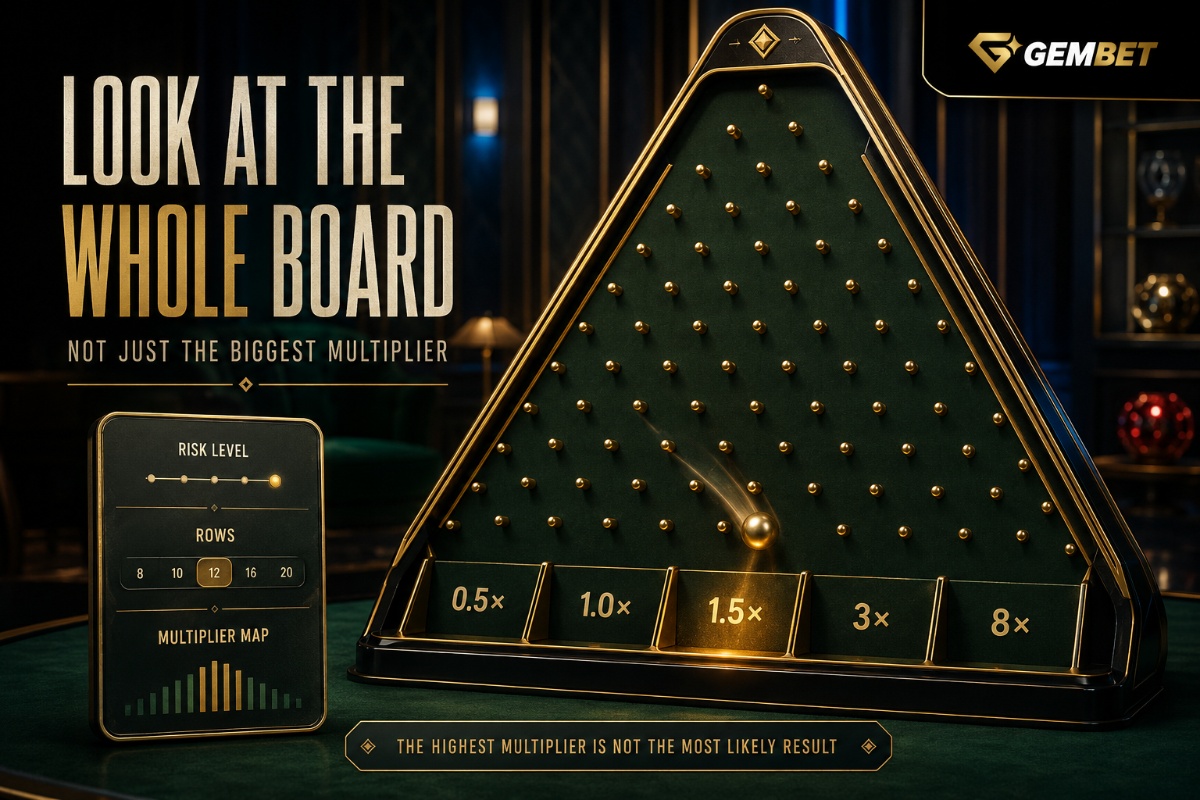
Plinko game is a fast casino-style format built around dropping a ball or disc through a field of pegs toward payout slots at the bottom. The path changes as the piece deflects left or right, so the final landing position cannot be controlled precisely once the round begins. On Gembet, the useful questions are the stake, the selected risk setting, the number of rows where configurable, and the multiplier attached to each landing zone.
The simple board can make Plinko game look easier to read than it is. A high edge multiplier or recent landing pattern does not guarantee the next result.
How does Plinko game work?
Plinko game normally starts with a stake and a board filled with staggered pegs. A ball drops from the top and changes direction as it contacts the pegs until it reaches one of the multiplier slots below. The payout is determined by the stake and the multiplier assigned to the final slot under the specific game rules.
Some versions also let the player change the risk level or number of rows. Those settings can alter multiplier distribution, so check the exact information panel before the first paid round.
1 A dramatic edge multiplier is not the most likely result
One of the easiest mistakes with Plinko game is focusing on the largest number printed at the edge of the board. A high multiplier shows a possible payout level, not how frequently the ball reaches that position.
Large edge values can look attractive, but frequency and payout size are different. Compare the full multiplier layout, not only the biggest number.
2 Risk settings can change the whole board
Where a version offers low, medium, or high risk, Plinko game may redistribute the multipliers across the landing slots. A lower-risk setting can concentrate more value around the centre, while a higher-risk setting can place more extreme outcomes toward the edges.
The label does not mean one mode is automatically better. It describes a different payout structure. Check the actual displayed multipliers after changing the setting instead of assuming the old board still applies.
3 More rows can change the route and payout map
Some Plinko game versions allow the number of rows to be adjusted. More rows create a longer path with additional peg interactions before the ball reaches the bottom. The multiplier map may also change when the row count changes.
Do not treat row count as a cosmetic setting. If the game changes the payout table at the same time, the risk profile of the round has changed too.
4 The drop position does not create guaranteed control
A player may prefer dropping from the centre or another visible starting point, but Plinko game should not be treated like an aiming challenge unless the exact rules explicitly make starting position part of the outcome model.
The visual path can create the impression that careful placement controls the final slot. In randomised casino versions, the important information is how the game generates and settles the result, not whether one release point looked successful a few rounds ago.
5 Recent landings are history, not instructions
Several centre finishes in a row can tempt players to expect an edge result next. Plinko game does not become obliged to balance a short sequence just because the recent board looks repetitive.
A history panel can be useful as a record of completed rounds, but it should not be used as proof that a particular slot is due. Short streaks can happen without changing the rules of the next drop.
6 Fast repeat play can make turnover easy to miss
Plinko game rounds can resolve quickly, which makes it possible to place many wagers in a short period. A small stake can therefore create substantial turnover when repeated often.
25 rounds × SGD 2 = SGD 50 turnover
60 rounds × SGD 2 = SGD 120 turnover
These calculations describe the total amount put into play, not expected loss. The point is that speed matters when reviewing a session.
7 Auto play changes execution, not uncertainty
If a Plinko game version includes auto play, the tool can repeat a chosen stake and setting for a selected number of rounds. It does not make the multiplier pattern more predictable.
Automation can also make several rounds pass with less active attention. Before using it, check the stake, risk level, row setting, stop conditions, and total number of rounds.
8 Bonus eligibility can be separate from game access
Being able to open a Plinko game does not mean every promotional balance can be used on it. Gembet’s current Help Center specifically lists Plinko with Mines and Crash among mini-games that can be excluded from certain welcome-bonus usage.
That means game availability and bonus eligibility should be checked separately. Read the terms of the specific promotion rather than assuming all casino balances work across every category.
What does a simple Plinko payout look like?
Imagine a fictional Plinko game round with an SGD 5 stake. If the ball lands in a slot marked 1.40×, the gross return under a simple stake-times-multiplier model would be:
SGD 5 × 1.40 = SGD 7
If another slot is marked 0.50×, the same SGD 5 stake would return SGD 2.50. These figures are examples only. Real multiplier maps depend on the exact game and selected settings.
Why do centre and edge slots often look so different?
A Plinko game board often uses a symmetrical layout where the centre contains more moderate values and the outer slots display more extreme multipliers. This visual structure reflects the way the game’s payout map is designed, but the exact distribution can vary.
How risk settings compare
| Setting | Typical visual pattern | Main thing to check |
|---|---|---|
| Lower risk | More moderate values around the centre | Complete multiplier map |
| Medium risk | Wider spread between centre and edge | How payouts are distributed |
| Higher risk | More extreme low and high outcomes | Edge values and low-value slots |
This table is a structural guide, not a guarantee about any specific title. Always use the values shown by the exact version being played.
Can a long streak of low multipliers make a high one due?
No. A run of low results can feel unusual, but Plinko game outcomes should not be treated as though the board owes the player a compensating result. The next round is settled under the same game rules rather than by a need to balance recent history.
Why visual physics can be misleading
The board resembles a physical peg machine, which can encourage players to study bounces as if they reveal a repeatable physical pattern. In an online Plinko game, the outcome logic is governed by the software and rules of the title, not by a player’s ability to reproduce a real-world drop perfectly.
How does Plinko game differ from Mines?
Both are quick-play mini-games, but the decision structure differs. Mines asks the player to reveal hidden positions and decide whether to stop after safe choices. Plinko game normally sets the stake and risk configuration before the drop, then the path plays out toward a multiplier slot.
If you want the hidden-grid format separately, the mines game guide explains mine count, safe reveals, cash-out decisions, and why favourite tile patterns do not guarantee a result.
Seven things to check before repeated play
- Confirm the exact stake per drop.
- Check the selected risk level.
- Verify the number of rows if it can be changed.
- Read the entire multiplier map, not only the highest value.
- Check whether auto play is active.
- Decide how many rounds you intend to play before starting.
- Read bonus eligibility separately from the game rules.
This routine keeps the format focused on settings you can actually control before the round begins.
Gembet treats Plinko as a mini-game for bonus purposes
Gembet’s current Help Center lists Plinko alongside Mines and Crash as examples of mini-games that can be excluded from certain welcome-bonus usage. This does not describe the mechanics of every Plinko game, but it does mean promotional eligibility should be checked before assuming a bonus balance can be used.
The individual game’s information screen remains the better source for its own stake limits, multiplier layout, row settings, and risk options.
Plinko game is clearer when the full board matters more than the top multiplier
Plinko game combines a simple visual idea with a payout map that can change when risk or row settings change. The largest multiplier is only one part of that map, and recent landings do not prove where the next ball will finish.
On Gembet, check the exact board, stake, available settings, and any auto-play controls before starting. If a promotion is active, verify whether the mini-game category is eligible separately.
The practical way to approach Plinko game is to focus on what can be chosen before the drop and accept what cannot be controlled after it begins. Plinko game becomes easier to understand when the full payout structure, rather than one dramatic edge value, stays at the centre of the comparison.
Experience the real deal with SG's top Live Dealers. Play Baccarat, Roulette & more.

